
Trump Inverts His Own “America First” Foreign Policy Mantra as Middle East Strategy Expands
President Donald Trump’s latest foreign-policy decisions are raising new questions about the meaning of his long-standing “America First” doctrine, with the administration increasingly committing American military power overseas even as Trump has repeatedly promised to reduce the country’s involvement in foreign conflicts.
The contradiction has become particularly visible as the United States expands its military presence in the Middle East while simultaneously scaling back some military cooperation with traditional allies in Asia.
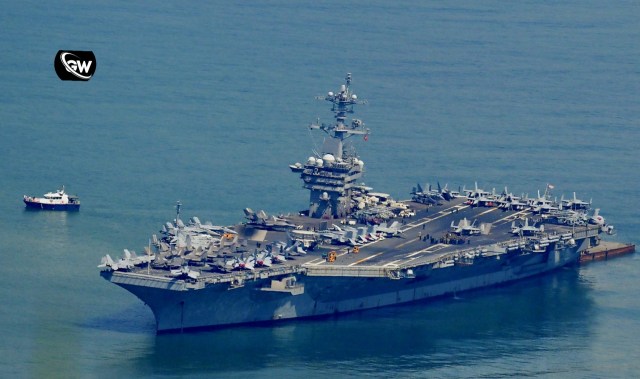
Trump recently instructed Defense Secretary Pete Hegseth to substantially reduce joint military exercises with South Korea, a decision that arrived alongside reports that the USS George Washington, a nuclear-powered American aircraft carrier, had been ordered toward the Middle East.
The juxtaposition has created a striking tension within Trump’s foreign-policy agenda.
For years, Trump has argued that American resources should primarily be used to protect U.S. interests rather than support military commitments that he believes place disproportionate burdens on American taxpayers and service members.
That philosophy became one of the central ideas behind his “America First” approach.
During his political rise, Trump criticized what he described as endless foreign wars and questioned the value of longstanding international commitments. His message appealed to voters who believed previous administrations had allowed the United States to become too deeply involved in conflicts and security arrangements abroad.
Trump’s current foreign policy, however, has increasingly involved direct demonstrations of American military power.
The shift is especially visible in the Middle East.
The administration’s confrontation with Iran has required American military assets, personnel and resources to play an increasingly prominent role in the region. The deployment of major naval forces represents a significant commitment at a time when Trump has continued to portray his foreign policy as fundamentally different from the interventionist strategies of previous presidents.
The USS George Washington’s reported movement toward the Middle East is therefore politically significant.
An aircraft carrier represents one of the most powerful instruments of American military power. Its deployment can serve as a deterrent, but it can also increase the United States’ involvement in a regional conflict.
That creates an obvious question for Trump’s supporters: If “America First” means avoiding unnecessary foreign entanglements, how should Americans understand a growing military commitment in the Middle East?
The answer from Trump’s administration is likely to be that the United States is acting in its own national interest.
That argument is consistent with Trump’s broader interpretation of America First.
The doctrine does not necessarily require complete isolation from the rest of the world. Instead, Trump and his allies have generally argued that American involvement abroad should produce a clear benefit for the United States.
Supporters can therefore argue that military action against threats to American interests is compatible with America First.
Critics see a different picture.
They argue that deploying additional American military power overseas risks reproducing the same type of foreign-policy commitments Trump spent years criticizing.
The tension becomes even more apparent when comparing the Middle East deployment with Trump’s approach to South Korea.
Trump’s decision to reduce military exercises with South Korea suggests a desire to limit some longstanding American commitments in Asia.
Joint military exercises are designed to maintain readiness and demonstrate the ability of allied forces to respond to threats, particularly from North Korea.
Reducing those exercises could be interpreted as part of Trump’s effort to reduce the costs associated with America’s global military presence.
But simultaneously increasing military resources in the Middle East creates a different impression.
Rather than simply reducing America’s international military role, Trump appears to be shifting where American power is concentrated.
That could represent a fundamental change in the meaning of his foreign policy.
Instead of withdrawing from global affairs, the administration could be moving toward a more selective and transactional approach in which military commitments are concentrated around conflicts that Trump believes directly affect American interests.
Such an approach would distinguish Trump’s policy from traditional isolationism.
The United States could remain heavily involved internationally while demanding that every commitment serve a clearly defined American objective.
Trump’s supporters have frequently rejected descriptions of his foreign policy as isolationist.
The administration’s actions provide some support for that argument.
The United States continues to maintain a vast network of military bases, alliances and strategic partnerships around the world.
Trump’s administration has also demonstrated a willingness to use American military power when the president believes doing so is necessary.
The current Middle East strategy therefore suggests that America First may be better understood as a doctrine of selective intervention rather than complete withdrawal.
That distinction matters because the costs of military engagement can become substantial.
Large-scale deployments require money, logistics, personnel and political commitment.
They can also create risks that extend beyond the original objective.
A military operation that begins with a limited purpose can become more complicated if adversaries retaliate or regional allies become involved.
That possibility has historically been one of the strongest arguments against unnecessary foreign intervention.
Trump himself has repeatedly emphasized the dangers of becoming trapped in open-ended conflicts.
His supporters have praised him for challenging the assumptions that led previous presidents into prolonged wars.
Yet the Middle East presents a particularly difficult test of that philosophy.
Iran is a major regional power with the ability to threaten American forces and partners across the region.
Any confrontation involving Iran can therefore produce consequences far beyond the immediate battlefield.
This makes the administration’s military decisions especially important for the future of Trump’s foreign-policy doctrine.
The question is not simply whether Trump is using American military power.
Presidents of both parties have done so.
The larger question is whether his administration can reconcile those decisions with the political promise that brought him back to the White House.
“America First” became popular partly because it offered voters a rejection of traditional Washington foreign policy.
Trump argued that American leaders had spent too much time worrying about other countries while neglecting domestic priorities.
That message remains important to his political coalition.
If the United States becomes deeply involved in another prolonged overseas conflict, however, Trump’s opponents could argue that his administration has moved away from one of its most important campaign promises.
The administration is likely to respond that the circumstances are different.
Trump’s foreign-policy philosophy has never been simply about refusing to use American power.
It has focused on using that power more aggressively when the president believes American interests are at stake.
That approach also explains Trump’s pressure on allies.
He has repeatedly demanded that partners contribute more to their own defense and has criticized arrangements in which he believes the United States carries an excessive share of the burden.
The same logic can apply to military exercises and deployments.
If Washington determines that a particular commitment does not provide sufficient value to the United States, Trump may seek to reduce it.
If another situation is considered a direct threat to American interests, he may instead increase military involvement.
That transactional approach is one of the defining characteristics of Trump’s foreign policy.
It also makes the current moment particularly consequential.
The Middle East deployment could become a short-term demonstration of American power that eventually winds down.
Alternatively, it could mark the beginning of a much larger American military commitment.
The outcome will influence how historians and political analysts assess Trump’s second-term foreign policy.
It could also shape the future of the Republican Party.
Trump’s movement has challenged the traditional internationalist wing of the Republican Party, which historically emphasized strong alliances and an active American role overseas.
The new Republican foreign-policy debate is increasingly divided between those who favor a restrained approach and those who believe American power should be used more aggressively against perceived threats.
Trump’s actions are likely to intensify that debate.
The decision to reduce some military cooperation with South Korea while increasing American military assets in the Middle East illustrates the difficulty of maintaining a consistent foreign-policy doctrine.
It suggests that Trump’s administration is not necessarily abandoning international engagement.
Instead, it is choosing where and when to engage.
For supporters, that is precisely what America First is supposed to mean.
For critics, it risks becoming a flexible slogan that can justify almost any foreign-policy decision.
The debate will ultimately depend on how the administration defines American interests and whether its military commitments produce the results Trump promises.
The Trump America First foreign policy debate is therefore entering another important phase.
Trump’s political brand was built around challenging conventional foreign-policy thinking and promising that American interests would come before international obligations.
But his administration is now confronting situations that require difficult choices about military power, alliances and overseas commitments.
The movement of American military assets toward the Middle East and the reduction of some exercises with South Korea demonstrate that Trump’s foreign policy is becoming increasingly complex.
The president may argue that both decisions are consistent with America First because each reflects a calculation about what serves U.S. interests.
Critics will continue to ask whether the growing use of American power overseas contradicts the anti-interventionist expectations created by Trump’s political movement.
For now, the answer remains unsettled.
What is clear is that Trump’s second-term foreign policy is testing the boundaries of the America First philosophy.
Rather than simply retreating from the world, the administration appears to be reshaping America’s international role according to Trump’s own priorities.
Whether that strategy ultimately strengthens the United States or pulls it into the very kind of overseas commitments Trump once promised to avoid will be one of the defining foreign-policy questions of his presidency.
About the Author


