
What Is a Blue Moon? Everything to Know About the Upcoming Blue Moon Celestial Event
A Blue Moon is one of the most widely recognized astronomical terms, yet it is often misunderstood. Despite its name, a Blue Moon usually does not appear blue in color. Instead, the term refers to a rare occurrence involving the timing of full moons.
The upcoming Blue Moon has already generated excitement among astronomy enthusiasts, photographers, and skywatchers who are eager to witness the celestial event.
Traditionally, there are two accepted definitions of a Blue Moon.
The most commonly used definition describes a Blue Moon as the second full moon occurring within a single calendar month. Because the lunar cycle lasts approximately 29.5 days, it is occasionally possible for two full moons to occur during the same month. When this happens, the second full moon is called a Blue Moon.
Another, older definition refers to the third full moon in a season that contains four full moons instead of the usual three. Astronomers and calendar experts continue to recognize both interpretations depending on the context.
The phrase “once in a blue moon” has become a popular expression because the event is relatively uncommon. While Blue Moons are not extremely rare, they do not occur every year.
On average, a Blue Moon appears roughly every two to three years, making it a special occasion for those who enjoy observing the night sky.
One of the biggest misconceptions surrounding the event is the belief that the Moon will actually turn blue.
In reality, the Moon generally maintains its normal appearance. However, under very unusual atmospheric conditions, the Moon can occasionally appear bluish. This may happen when particles from volcanic eruptions, large wildfires, or dust storms scatter red wavelengths of light and allow more blue light to pass through the atmosphere.
Such occurrences are extremely rare and unrelated to the official astronomical definition of a Blue Moon.
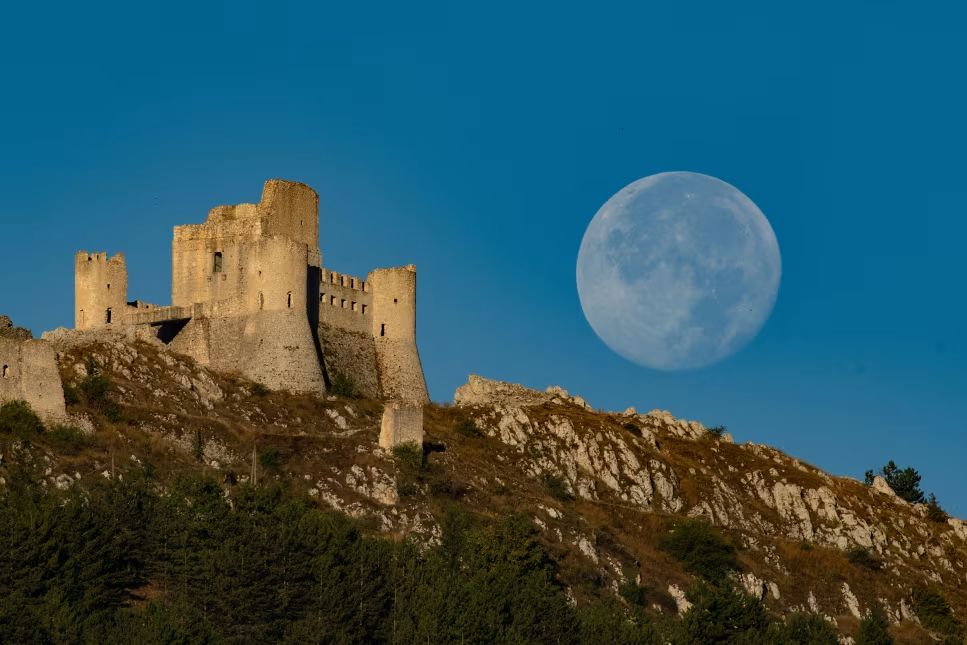
Astronomy experts note that the upcoming event will look much like any other full moon to the naked eye. Nevertheless, it remains significant because of its rarity and cultural popularity.
The full moon is expected to appear brightest shortly after moonrise, offering ideal viewing opportunities for observers around the world.
Photographers often look forward to Blue Moons because they provide a chance to capture dramatic images of the lunar surface against city skylines, mountains, oceans, and other landscapes.
Skywatchers do not need special equipment to enjoy the event. The Moon will be visible without telescopes or binoculars, although optical instruments can reveal additional details such as craters, ridges, and darker lunar plains known as maria.
Many cultures throughout history have attached symbolic meanings to full moons, including Blue Moons. Some traditions associate them with change, reflection, renewal, or spiritual significance.
The event has also inspired books, songs, folklore, and popular sayings that have helped maintain public fascination with the phenomenon.
Scientists continue to study the Moon because it provides valuable information about the formation and evolution of Earth and the solar system. Lunar observations also play an important role in modern space exploration programs.
The growing interest in astronomy has led many people to pay closer attention to events such as eclipses, meteor showers, planetary alignments, and Blue Moons.
As the upcoming Blue Moon approaches, experts encourage people to check local moonrise times and weather forecasts for the best viewing conditions.
Whether you are a seasoned astronomy enthusiast or simply someone who enjoys looking at the night sky, the event offers an opportunity to appreciate one of nature’s most captivating sights.
Although the Moon may not actually appear blue, the upcoming Blue Moon remains a fascinating celestial event that continues to capture the imagination of people around the world.
About the Author


